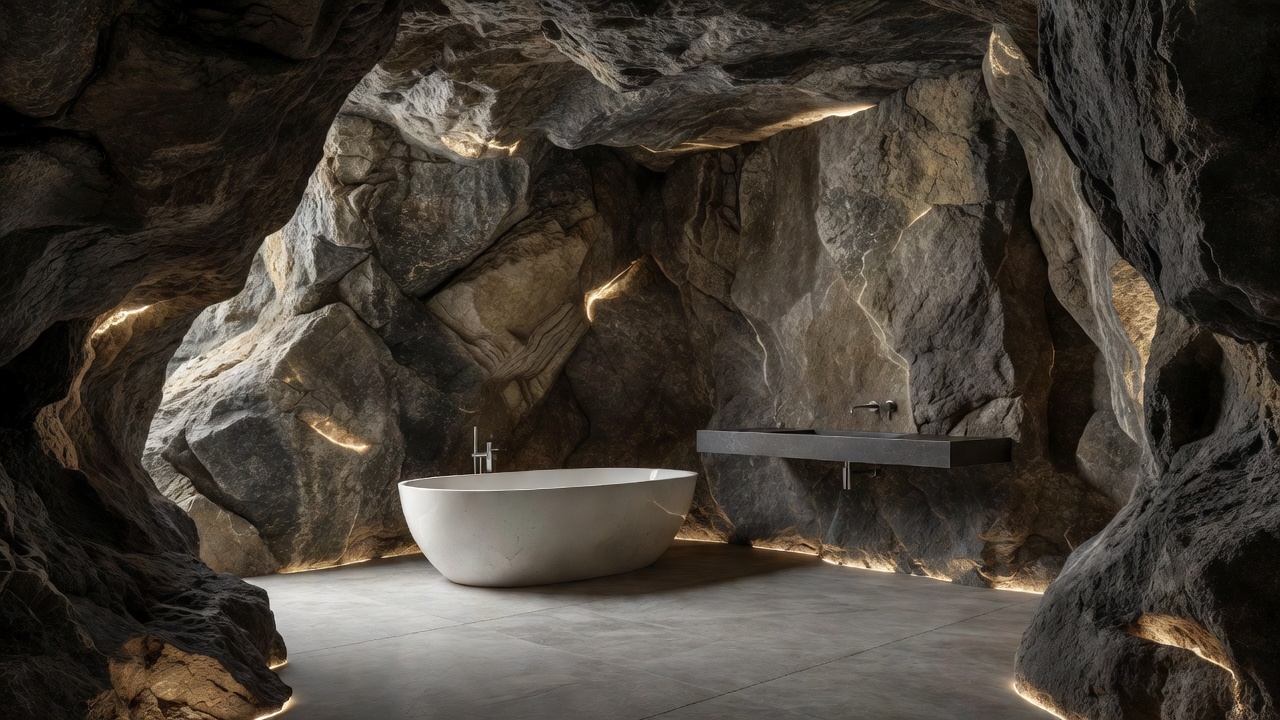
Rock creates a persuasive impression of stability. The walls feel substantial, outdoor noise seems distant and the air may be cooler than the courtyard. None of those impressions proves that a room will remain comfortable through a long shower, a hot afternoon or a cold night. Habitability comes from the interaction between the site, its construction, the weather and the systems installed within it.
A useful enquiry separates four subjects: fresh air, moisture, temperature and sound. Operators sometimes answer all four with a single phrase such as “climate controlled.” Ask them to unpack it. You do not need an engineering report, but you do need to know what is supplied, what you can adjust and how help is obtained if the room does not suit you.
Fresh air is not the same as cooling
An air-conditioning unit may recirculate indoor air while changing its temperature. That does not, by itself, explain how outside air enters the room. A door that opens onto a courtyard may provide occasional ventilation, but it may not be practical to leave it open overnight because of privacy, insects, noise or security. Ask how fresh air is supplied when the door and windows are closed.
Different rooms can use different solutions, even within the same hotel. A chamber near the façade may behave differently from one further inside the rock. Ask whether ventilation runs overnight, whether it has guest controls and whether there is audible fan noise near the bed. Do not switch off unfamiliar equipment solely because it appears to be an unnecessary background system; ask staff to explain its purpose.
Changes how warm or cool the space feels.
Explains how indoor air is replenished when openings are closed.
Removes moisture near its source.
Determine what you can adjust without waiting for assistance.
Follow the moisture
A bath placed against raw stone can be visually memorable. It also introduces water vapour into an enclosed environment. The important questions concern extraction, separation and drying, rather than whether the bathroom looks sufficiently luxurious. Ask if the bathing area has a door, where the extractor operates and whether wet towels can dry without making the sleeping space feel humid.
Natural colour variation in stone is not a reliable diagnosis of damp, and photographs cannot establish indoor air quality. Equally, a persistent musty smell, visible water entry or repeatedly wet surfaces should not be dismissed as inevitable cave character. Report concerns promptly and request an assessment or alternative room. If you have respiratory sensitivities, discuss your needs with the operator before booking and obtain personal medical advice where appropriate.
Health context: WHO guidelines for indoor air quality: dampness and mould. This general reference is not a diagnosis of any named property or a substitute for medical advice.
Thermal mass is a buffer, not a guarantee
Surrounding rock can slow temperature changes, but the result depends on climate, depth, exposure and occupancy. A protected chamber may need heating during a cold season, while a glazed entrance can introduce heat on a sunny day. “Naturally cool” is therefore an incomplete answer if you are travelling in winter or prefer a particular sleeping temperature.
Ask what heating and cooling are available in your exact category during your dates. Establish whether settings are individual, centrally scheduled or limited by the building’s conservation requirements. Heated floors, where offered, may respond slowly; portable equipment may add noise. The issue is not whether one system is inherently superior, but whether its operation is compatible with your expectations.
Listen beyond the stone
Thick rock can reduce some transmission paths, but sound also travels through doors, shared openings, plumbing and connected spaces. A hard-surfaced room can have a lively internal echo even when the outdoors is quiet. Ask about adjacent rooms, service areas, late dining, terrace use and equipment positioned near the sleeping alcove.
For a light sleeper, a modest room away from circulation may be preferable to an impressive suite beside a busy courtyard. If photographs show a bath open to the bedroom, consider the sound of water and extraction as well as the view. Privacy between travelling companions is part of comfort too, particularly when bathroom partitions do not reach the ceiling.
Use official descriptions carefully
Cave accommodation appears in very different climates. Cuevas Al Jatib near Baza in Andalusia and Desert Cave Hotel in Coober Pedy in South Australia are useful reminders that “underground” is not a climate specification. Neither should be used to predict conditions in Matera or Cappadocia. Read each operator’s current facilities information and ask about the actual season and room offered.
Property context: Cuevas Al Jatib and Desert Cave Hotel. Mention does not imply an inspection, endorsement or shared technical standard.
Ask this before paying, then test the controls when you arrive. The purpose is not to make a cave room behave exactly like a conventional hotel room. It is to ensure that the distinctive pleasure of inhabiting rock rests on dependable, understandable comfort.