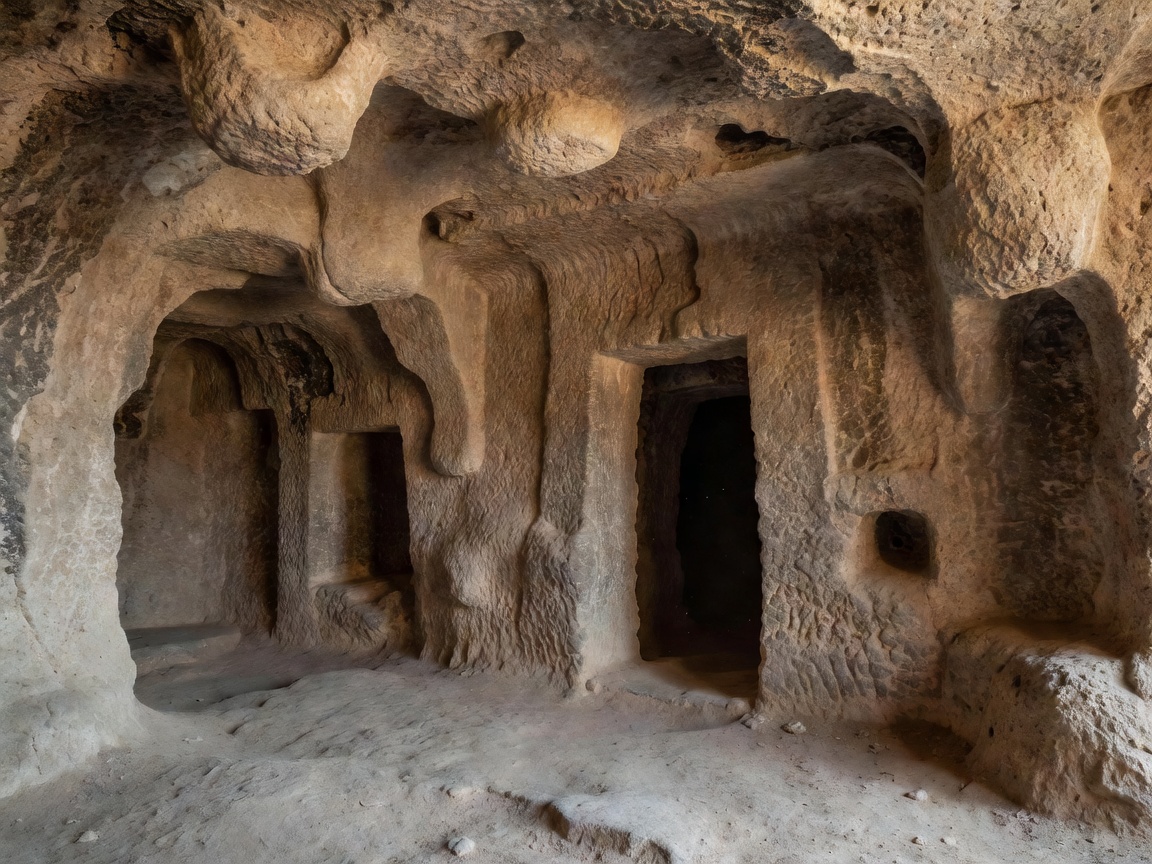
The first useful question is not whether a room looks like a cave. It is how that room came into being. A natural cavity adapted for hospitality, a chamber excavated into a hillside and a conventional building dressed in stone can share a similar photographic vocabulary. Their spatial character, relationship to daylight and maintenance needs may be very different. None is automatically a better place to sleep; the point is to know what you are choosing.
“Cave resort” is a broad travel description, not a universal technical standard. Even within one property, different rooms can occupy different kinds of structure. A dramatic reception chamber does not establish the construction of the suite you will receive. Ask the operator to identify your room category on a plan and explain which walls and ceilings are original rock, restored masonry or modern construction.
Read the landscape before the lobby
In Cappadocia, volcanic formations and a long history of excavation give rock-cut accommodation its distinctive setting. Göreme, Uçhisar and Ürgüp belong to the same wider region, yet they are not interchangeable addresses. A position beneath a prominent rock mass can feel different from a room overlooking a populated valley. Wind exposure, approaches and the arrangement of neighbouring terraces all influence the experience.
UNESCO documents the combined natural and cultural importance of Göreme National Park and the Rock Sites of Cappadocia. That record is valuable context, but it should not be mistaken for an assessment of any hotel. For accommodation examples, Museum Hotel in Uçhisar, Argos in Cappadocia and Yunak Evleri in Ürgüp provide distinct official accounts of their own settings. Read them as property descriptions, then ask room-specific questions.
Sources: UNESCO: Göreme and Cappadocia; Museum Hotel; Argos in Cappadocia; Yunak Evleri. These references establish context and examples, not a ranking.
Carved does not mean untouched
A comfortable cave suite is usually an act of adaptation. Floors must support ordinary movement; bathrooms need drainage; lighting needs wiring; and doors must close securely against weather and unwanted access. The most successful interventions can look almost invisible. That apparent simplicity should not lead you to assume that the room is preserved exactly as it was found.
Look closely at the meeting between old and new. A freestanding bathroom enclosure may preserve the legibility of the chamber while controlling moisture. A built façade may provide the principal weather barrier. A smooth floor may improve usability while concealing services. These are not necessarily compromises. They are choices worth understanding, especially if the authenticity of the room matters to you.
Matera offers another architectural conversation
In Matera, in the Italian region of Basilicata, the Sassi combine excavated spaces with built fabric in a dense historic settlement. The experience is therefore not simply “sleeping underground.” You may also be inhabiting a network of lanes, thresholds, terraces and neighbouring dwellings. Sasso Caveoso is a useful place name to recognise when reading descriptions, but a location within the Sassi still tells you little about a particular room’s exposure.
Sextantio Le Grotte della Civita, Aquatio and Sant’Angelo are examples to consult through their own materials. Do not flatten their different approaches into a single promise of cave luxury. Compare the actual room offered, the relationship between sleeping and bathing areas, and whether the photographs show shared spaces or your private accommodation.
Sources: UNESCO: Matera; Sextantio; Aquatio; Sant’Angelo. Consult the current official room descriptions before making arrangements.
Let the rock remain particular
Beyond these better-known settings, the Loire offers a different rock-cut tradition. Les Hautes Roches at Rochecorbon provides a useful French reference point. Its setting should not be treated as equivalent to either Cappadocia’s volcanic landscape or Matera’s urban fabric. Climate, geology and patterns of occupation change the practical questions as well as the visual mood.
The observant guest resists the temptation to ask only how spectacular the stone looks. Ask whether ceilings narrow over circulation routes, whether natural texture makes the floor uneven, and how closely adjacent rooms connect. A quiet-looking chamber may sit beside a service corridor. An intimate alcove may require bending to reach the bedside. Specific answers are more useful than another atmospheric photograph.
Property reference: Les Hautes Roches. General practical observations on this page are questions for assessment, not findings from a structural survey.
Once you understand the room’s physical identity, follow its opening to the outside. The next distinction is not between cave and non-cave, but between spaces that offer a satisfying rhythm of enclosure and release—and spaces that may feel too inward for the way you travel.