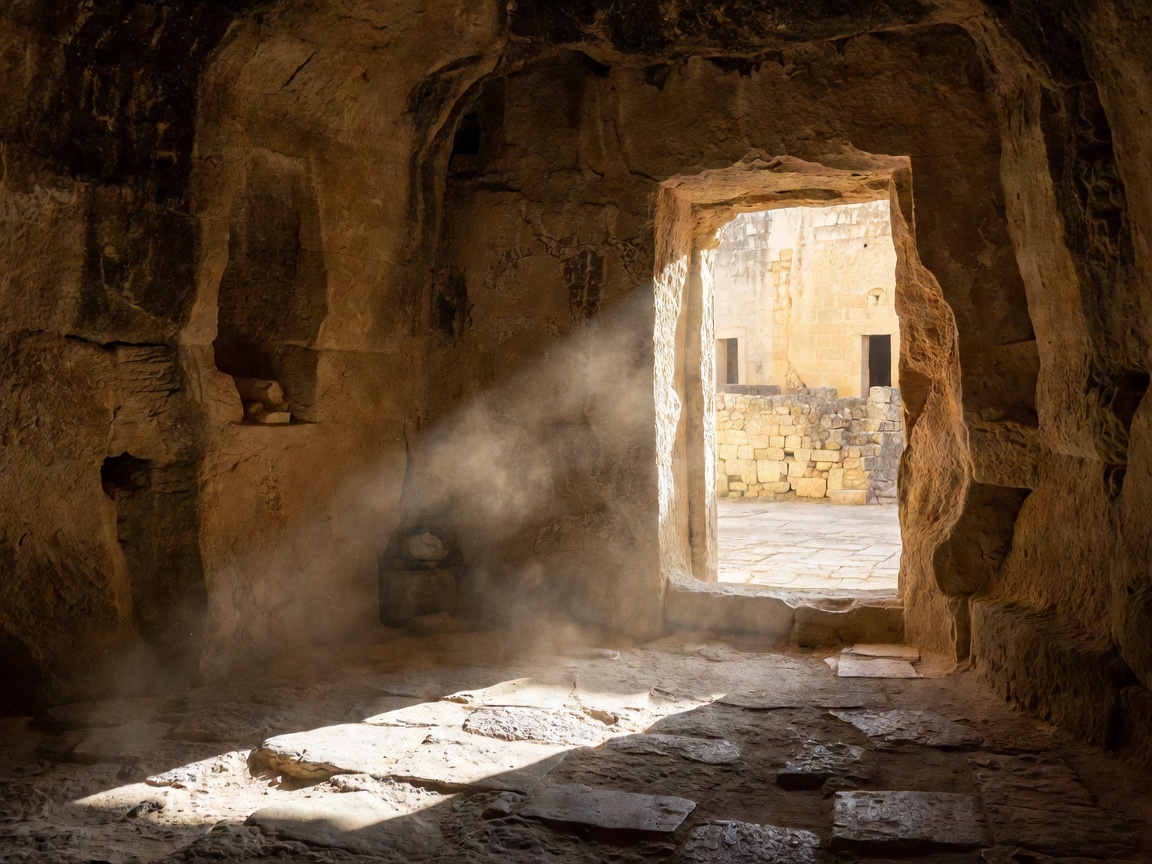
Daylight gives a room more than brightness. It marks the passing hours, offers a visual connection beyond the walls and helps a guest understand where they are. In a cave suite, the relationship can be unusually concentrated: one doorway, one window or one small courtyard may perform most of that work. A room with a large floor area may therefore offer less useful daylight than a compact room with a better opening.
Begin by locating the bed, the seating area and the principal opening on the same plan. Can you see the sky while sitting down? Is the reading chair beside daylight, or is the bright part of the room mainly a circulation space? Does the bedroom borrow light through another chamber? These questions reveal more than a simple count of windows.
Depth changes the experience
Light falls away as it travels into an enclosed space, and turns, partitions and low openings can interrupt its path. A deep sleeping alcove may be beautifully restful at night yet depend on electric light throughout the day. That can suit a guest who spends daylight hours outside. It may be less satisfactory for someone planning to read, work or recover from a long journey in the room.
Ask for an ordinary daytime photograph taken from the back of the chamber toward the entrance, and another taken in the opposite direction. Neither needs to be professional. Together they help explain how brightness is distributed. A wide-angle image made with a long exposure cannot establish how the room will feel to your eyes.
Original explanatory section, not to scale. It illustrates a principle rather than predicting illumination in any named property.
A courtyard is not necessarily private
Courtyards and terraces can provide the release that makes an enclosed room enjoyable. They can also be shared routes, gathering places or overlooked spaces. A private seating area is not always visually secluded, and a private entrance may still face a public lane. Ask who passes the opening, at what times, and whether screening can be used without losing most of the daylight.
In the Sassi of Matera, the relationship between dwellings and circulation is part of the settlement’s character. In Cappadocia, hillside terraces and room entrances can occupy several levels. These contexts are reasons to ask precise questions, not evidence that every room lacks privacy. The UNESCO records describe the wider places; only the operator can explain the current arrangement outside your door.
Context: UNESCO: the Sassi of Matera and UNESCO: Göreme and the Rock Sites of Cappadocia. Neither source assesses individual guest-room privacy.
Orientation and season matter
A room described as sunlit may receive direct sun only during a limited part of the day or year. A neighbouring wall, deep overhang or steep hillside can alter the result. Ask what happens during your travel month, rather than relying on an image whose season is unknown. Morning light, evening glare and persistent shade create different daily rhythms.
Consider heat as well as illumination. A glazed entrance can bring welcome brightness while requiring shading or cooling. A sheltered courtyard can feel pleasant in one season and still in another. These are ordinary design trade-offs, not defects unique to caves. The useful question is whether the arrangement supports your habits: early coffee outdoors, a shaded afternoon rest, or an indoor desk with a view.
Electric light should support, not disguise
Warm lighting grazing rough stone can create remarkable depth, but atmosphere is only one task. You also need to find a suitcase, read comfortably and navigate to the bathroom at night. Look for bedside controls, independently switched lamps and light where the floor level changes. A single dramatic lighting scene may be less useful than several modest, well-positioned sources.
If darkness is important for sleep, ask about curtains, glazed doors and exterior lighting. A cave chamber is not automatically a blackout room. Equally, if enclosure makes you uneasy, do not assume that decorative lamps will substitute for a visible outside connection. Request an outer room, a courtyard-facing category or a more conventional alternative rather than treating a deeply internal suite as a test of endurance.
Official galleries from properties such as Argos in Cappadocia and Sextantio can introduce different spatial arrangements. Use those images to frame questions, not to infer the conditions in every category. The most successful choice is not the brightest cave room in the abstract. It is the room whose balance of shelter and openness fits the way you want to inhabit it.
Visual starting points: Argos in Cappadocia and Sextantio. Confirm the identity of every pictured room directly.